
Posts

What a Hotel Bathrobe Can Teach You About Marketing

I don’t think anyone has ever booked a hotel because of the bathrobe. You might care about the location, the view, the pool, the restaurant, the size of the room or whether they have those horrible resort fees. The robe is probably somewhere around number 147 on the list.

Yet there’s something about getting out of the shower in a nice hotel and putting on that giant white bathrobe that changes the experience. Suddenly you’re walking around the room differently. Maybe you order room service. You sit by the window drinking coffee. For some reason a hotel bathrobe can make an otherwise normal person feel like they own a vineyard and are waiting for their attorney to finish reviewing the paperwork from a very important acquisition.

It’s silly, but that’s exactly why I find it interesting.

The robe doesn’t actually make the hotel room better. It doesn’t improve the mattress. It doesn’t make the room larger or give you a better view. In fact, if the hotel quietly removed the robes before you arrived, there’s a pretty good chance you wouldn’t complain because you probably weren’t expecting to use one in the first place.

But once it’s there, it contributes to the feeling that you’re somewhere a little special.

Hotels are unusually good at this. Think about all the little things that have almost nothing to do with renting a room for the night. The ridiculously heavy lobby doors. The smell when you walk inside. The lighting. The music playing somewhere that you can’t quite locate. The way the towels are folded. The glass your drink comes in at the bar.

Go to a really nice hotel and someone has thought about almost all of it.

Then think about how most companies approach marketing. We spend an incredible amount of time thinking about what we’re going to tell people. What’s the headline? What’s the slogan? What should the website say? What are we going to post on social media?

Those things matter, obviously. I make a living thinking about many of them. But I sometimes wonder whether we’re spending too much time trying to tell customers what kind of company we are and not enough time giving them little reasons to reach that conclusion themselves.

There’s a big difference between a business telling you it’s high-end and experiencing something that feels high-end.

This doesn’t necessarily mean spending a lot of money either. I’ve been to expensive restaurants where everything technically looked beautiful but something about the experience felt cold. I’ve also been to inexpensive little places where someone remembers your name, brings you something you didn’t order because they thought you’d like it, or packages something in a way that makes you smile when you open it.

Those things become part of the product even though they’re not technically the product.

Cities do this too, although they don’t usually think of it as marketing. A city can spend money developing a new logo and come up with a slogan about being a great place to live, work and play. Nearly every city seems to be a great place to live, work and play according to its own website.

But imagine arriving in that same city and finding beautiful landscaping, clean streets, interesting public art, comfortable benches, flowers, good lighting and storefronts that look cared for. You don’t need the slogan anymore. You’re already forming an opinion.

The opposite works just as quickly. You can have the greatest branding campaign in the world, but if the first thing someone sees after exiting the highway is weeds, faded signs and an abandoned shopping center, the weeds are probably going to win the branding argument.

That’s why I keep coming back to the bathrobe.

Every business probably has its own version of one. Some small, seemingly unnecessary detail that doesn’t appear in the main sales pitch but changes how the customer interprets everything around it.

Maybe it’s how you answer the phone. Maybe it’s what happens immediately after someone buys. It could be your packaging, your waiting room, the way an employee greets someone, or something so minor nobody in the company has thought about it in years.

I think it would be an interesting exercise for a business to forget about its logo and advertising for an afternoon and walk through the entire customer experience looking for those things.

What’s your bathrobe?

And perhaps more importantly, what’s the equivalent of a cheap scratchy towel that is quietly undoing everything your advertising promised?

Because customers probably aren’t separating all these things as neatly as we do.

To them, it’s all the hotel.

Contact us today at GRIPD.com to get started on your marketing strategy!
How to Use AI in Marketing Without Losing What Makes Your Brand Unique

Everyone is talking about how AI is changing marketing. I think we’re talking about the wrong problem.

The issue isn’t that businesses are using AI. The issue is that they’re using it exactly the same way.

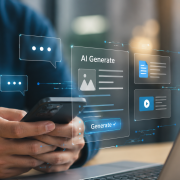
Scroll through LinkedIn or Facebook today and you’ll notice a pattern. Holiday graphics, inspirational images, polished illustrations, and perfectly composed visuals that all have the same unmistakable AI aesthetic. Individually, many of them look impressive. Collectively, they become invisible.

This is one of the oldest lessons in marketing.

When everyone adopts the same tactic, the tactic stops creating differentiation.

Years ago, businesses relied on the same stock photography. Then everyone had the same smiling call center representative with a headset and the same staged boardroom handshake. Today, we’ve simply replaced stock photos with AI-generated images.

The technology changed.

The marketing mistake didn’t.

The brands that will benefit most from AI won’t be the ones producing the most AI content. They’ll be the ones using AI to amplify what already makes them different.

Customers don’t remember businesses because their graphics were beautiful.

They remember businesses because they stood for something, told a compelling story, demonstrated expertise, or made them feel something unique.

AI has made professional-quality design accessible to almost everyone. That’s remarkable.

But when beautiful graphics become abundant, they’re no longer the competitive advantage.

Original thinking is.

Authenticity is.

A distinct point of view is.

In the years ahead, I believe we’ll see a shift. Businesses that use AI to accelerate creativity will thrive. Businesses that use AI as a substitute for creativity will blend into an increasingly crowded sea of sameness.

Technology can make your marketing faster.

It still can’t make it memorable.

And in the end, memorable is what builds brands.

Ready to use AI without losing what makes your brand different? Let’s build marketing that is faster, smarter, and still unmistakably yours.

Visit gripd.com to contact us today!

AI Tools We’re Mastering So You Don’t Have To

We hear it all the time. “Can’t I just use AI tools myself?”

Sure. You can also buy ingredients and call yourself a chef. Doesn’t mean the food’s going to be any good.

The AI landscape is massive, overwhelming, and constantly changing. For most business owners, keeping up with it isn’t just hard, it’s not worth the time. That’s why we’ve made it our job to know the tools, test the tech, and integrate the best of them into our client work. Here are the AI tools we’re mastering so you can focus on running your business while we focus on growing it.

AI for Content Creation & Marketing

AI’s already transforming the way content gets made, but only if you know where (and how) to
use it.

  • Jasper – Think of it as ChatGPT with a marketing degree. Killer for blogs, ad copy, and
    anything that needs your brand voice baked in.
  • Copy.ai – Your go-to for snappy, short-form content like email subject lines, CTAs, and
    social captions.
  • Runway ML – Lightning-fast AI video editing for brands that want slick visuals without
    the full production crew.
  • Synthesia – Avatar-led videos with AI voiceovers. Think training videos, company intros,
    or explainer clips—done without a camera.
  • Midjourney / DALL·E – Image generation for social posts, web design, and brand visuals
    that don’t look like stock photos.

AI for Customer Service & Chatbots

Want 24/7 service without 24/7 staffing? AI chatbots are your front line.

  • Intercom AI – Smart support bots that answer questions before customers ever hit your
    inbox.
  • Drift – Conversational bots that actually generate leads—not just frustration.
  • Tidio – Budget-friendly automation for businesses just starting to scale their support.

AI for Business Intelligence & Analytics

Data’s only useful if you understand it. These tools help us make sense of the numbers—and
turn them into action.

  • Tableau GPT – Ask it questions in plain English, get visual answers backed by serious
    data.
  • Google Looker – Dashboards and reports powered by real-time, AI-enhanced insights.
  • Crimson Hexagon (Brandwatch) – Deep social listening and sentiment analysis, so we
    know how your audience really feels.

AI for SEO & Digital Advertising

No one wants to rank on page two. These tools help us build content and campaigns that get
found and get clicks.

  • Surfer SEO – Builds high-ranking content based on data from top-performing pages.
  • Clearscope – Tells us exactly what your content needs to outrank your competitors.
  • Adzooma – AI that manages and optimizes your ads across Google, Facebook, and Microsoft. Yes, all at once.

AI for Sales & Lead Generation

AI can’t close the deal for you, but it can tee up better leads and sharpen your pitch.

  • HubSpot AI – Smarter CRM, cleaner automations, and more efficient pipelines.
  • Seamless.AI – Lead generation with enriched contact data. Less hunting, more selling.
  • Gong – Analyzes sales calls to tell us what’s working, what’s not, and how to close more
    deals.

AI for HR & Recruitment

Hiring just got way more efficient.

  • HireVue – AI video interviews that screen candidates before they ever reach your team.
  • Pymetrics – Uses neuroscience games (yes, really) to match candidates with the right
    roles.
  • Eightfold.ai – Hiring, retention, and workforce planning—backed by big data.

AI for Automation & Productivity

They are the tools that save time, reduce errors, and help us (and our clients) get more done,
faster.

  • Zapier AI – Connects your favorite apps and builds smart workflows in seconds.
  • Notion AI – Keeps internal knowledge organized, searchable, and sharable.
  • Microsoft Copilot – Brings AI right into Excel, Word, and the rest of the Microsoft suite.

AI for Cybersecurity & Fraud Detection

AI isn’t just for marketing, it’s also protecting your business behind the scenes.

  • Darktrace – Real-time threat detection that adapts as cyberattacks evolve.
  • Falcon by CrowdStrike – AI-powered endpoint protection that stops breaches before they start.

The Bottom Line:

You don’t need to learn all these tools. You just need a partner who has. At GRIP.D, we’re staying ahead of the curve so you don’t have to play catch-up. Whether it’s building smarter campaigns, designing content faster, or uncovering opportunities in your data, we’re using AI to work smarter, not just faster.

Let’s turn all this potential into real results. Contact us today!

AI Isn’t the End of Marketing Agencies, It’s Why You’ll Need a Better One

AI is here. That’s not up for debate anymore.

It’s not “coming” or “on the horizon”—it’s integrated into your browser, your inbox, your news feed. Tools like ChatGPT, Jasper, and Canva’s Magic tools have made it feel like everyone suddenly has access to their own creative department.

And yeah, that’s a little unnerving for those of us in the business of providing those services. But here’s the reality: AI isn’t going to replace great marketing agencies. It’s going to expose the ones that never had much to offer in the first place.

The agencies that were just selling you fluff—templated social posts, one-size-fits-all email campaigns, logos that looked like they were made in an airport Starbucks—those are the ones who should be nervous.

The rest of us? We’re adapting. And getting sharper.

Why AI Doesn’t Replace Us—It Supercharges What We Do

Let’s break down the real reasons clients will need agencies like ours in an AI-driven world:

  1. AI Is Advanced, But It’s Not Smart: AI can generate. It can automate. It can analyze. But it can’t interpret nuance. It can’t make strategic calls. It can’t understand the emotional nuance of a brand or know why one sentence resonates and another falls flat. You still need someone who knows what to do with the output.
  2. Everyone’s Using the Same Tools: If all businesses use the same AI prompts, from the same platform, with no strategic oversight…then guess what? Everyone starts to sound the same. That’s a problem. Your business doesn’t win by blending in.
  3. AI Needs a Driver: You wouldn’t hand someone a Formula 1 car and call them a professional racer. The machine is impressive—but it doesn’t drive itself. AI’s the same. It’s a tool. A powerful one. But one that needs human strategy, intuition, and creativity to steer it toward actual results.

What We’re Doing About It at GRIP.D

We’re not pretending AI isn’t coming for the industry. That kind of denial ends careers. We’re leaning into it. Studying it. Training on it. Testing it. Finding the best platforms. Figuring out how to blend them with real human strategy in a way that makes marketing more personal, more predictive, and more effective.

We’re not just learning how to use AI—we’re learning how to make it work for our clients. So if you’re a business owner wondering if you can skip the agency and just “do it with ChatGPT,” the answer is: You can try.

But if you want messaging that doesn’t sound like everyone else’s, design that still feels human, and strategy rooted in both data and experience, we’re ready to help you navigate this next chapter.

Because we’re not afraid of AI. We just refuse to be replaced by it.